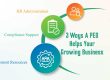

A PEO for small business owners is worth it when HR administration eats more time than it returns, and unnecessary when HR needs stay simple.
A Professional Employer Organization (PEO) is a firm that provides comprehensive HR solutions for small and medium-sized businesses. PEOs handle payroll, benefits, tax administration, and regulatory compliance assistance.
Businesses contract with a PEO to assume these responsibilities, which allows the company to concentrate on the operational and revenue-producing side of its operations. Outsourcing HR in this way frees a small team to focus on core competencies and growth.
PEO services cover payroll and payroll tax filings, workers’ compensation, and a wide range of employer-related services. More cost-effective alternatives exist for certain types of businesses, depending on their needs, which makes a deliberate comparison worth the effort before any contract is signed.
When Is a PEO for Small Business the Right Choice?
A PEO earns its place when HR administration consumes owner time, when competitive employee benefits are hard to fund alone, or when compliance exposure exceeds in-house capability. In-house HR management stays more cost-effective for organizations with a small staff and simple HR needs. The decision turns on headcount, benefit ambitions, compliance exposure, and administrative cost.
Time is the first test. PEOs provide comprehensive HR solutions and free up owner hours, which moves attention from administrative duties to strategic growth initiatives.
Benefits are the second test. If offering competitive benefits to attract and retain top talent is a challenge due to your size, the co-employment model gives access to better benefit plans than a small employer could afford alone.
Cost is the third test. A PEO is not a one-size-fits-all solution, and each business has unique needs and circumstances, so weigh the fee against the pros and cons before deciding.
The PEO Services market value is anticipated to reach USD 147,134 million by 2030, with a CAGR of roughly 11.1%.
How Does a PEO Benefit Your Company?
A Professional Employer Organization delivers seven measurable benefits to a small or mid-sized company:
- Streamlined HR processes: A PEO manages payroll, benefits, and compliance, so your company can focus on its core competencies and strategic growth initiatives.
- Access to better benefits: Through the co-employment model, PEOs provide small businesses with more comprehensive benefit packages — health insurance, retirement plans, and similar — than those businesses could otherwise afford.
- Reduced legal risk: PEOs employ legal experts who stay updated on labor laws and regulations, which helps your company navigate employment law and lowers the risk of non-compliance and potential lawsuits.
- Improved employee management: PEOs offer recruitment, onboarding, performance management, and employee training, which helps you manage your workforce more effectively.
- Cost savings: Because PEOs work with multiple companies, benefit administration reaches economies of scale, and that efficiency can result in cost savings for your business.
- Administrative efficiency: Reducing the time and resources spent on HR administration increases overall efficiency, which can lead to improved productivity and profitability.
- Expert advice: PEOs provide expert HR advice covering everything from labor law compliance to best practices in HR management, which supports informed decisions on human resource management.
How Important Is a PEO for Business Growth?
A PEO matters most to small and medium-sized businesses in a growth phase, because the complexities of managing HR functions increase as the organization scales and pull resources away from growth-oriented activities. PEO support keeps benefits competitive, adds HR technology, and reduces labor law risk.
Employee benefits are the first growth lever. A PEO service provider allows an organization to offer competitive employee benefits usually reserved for larger companies, which aids in attracting and retaining top talent — a crucial element of business growth.
HR technology is the second lever. PEOs often provide access to HR technology platforms that enhance efficiency and generate valuable data insights, streamlining HR processes and reducing time spent on administrative tasks.
Compliance risk is the third lever. PEOs mitigate risks associated with non-compliance with labor laws, helping to prevent legal issues that disrupt business operations and impact growth.
A caveat applies to all three. Each business’s needs and circumstances are unique, so the decision to use a PEO belongs at the end of careful consideration rather than the start.
Why Does a PEO Improve Business Efficiency?
A Professional Employer Organization raises productivity and effectiveness through five specific mechanisms:
- Streamlining HR operations: One primary advantage of partnering with a Professional Employer Organization is its ability to streamline your human resources operations.
- Mitigating compliance risks: Compliance with employment laws and regulations is complex and time-consuming, particularly for small and medium businesses without dedicated legal teams.
- Access to technology: Many PEOs leverage modern HR technology to automate processes, provide self-service portals, and enhance data management.
- Employee management: PEOs offer tools and resources for better employee management, including onboarding, performance management, and training programs.
- Benefits administration: Offering employee benefits is crucial for attracting and retaining talent, and managing those benefits is complex work a PEO absorbs.
What Should You Check Before Choosing a PEO?
Check three things before signing with a PEO: your current HR workload and pain points, your headcount and growth projection, and a cost-benefit comparison that counts time and risk rather than fees alone. A PEO that suits a fast-scaling business can be the wrong fit for a stable one with simple HR needs.
| What to assess | Why it decides the outcome |
|---|---|
| Current HR needs and challenges | Assess your current HR processes and identify pain points or areas that need improvement. Tasks that take up a significant amount of time or are too complex to handle efficiently are the ones a PEO is built to absorb. |
| Size and growth projections | Consider the size of your workforce and your anticipated growth. A Professional Employer Organization is particularly beneficial for small to medium-sized businesses growing quickly and needing to scale their HR functions efficiently. |
| Cost-benefit analysis | Weigh the costs of using a Professional Employer Organization against the potential benefits and savings, including not just direct costs but savings in time, resources, and risk mitigation. |
Should Your Small Business Use a PEO?
A PEO for small business operations earns its fee when payroll, benefits administration, compliance, and risk mitigation grow past what the current team handles well. Access to better employee benefits and HR technology, along with improved administrative efficiency and expert advice, are the notable advantages of partnering with a Professional Employer Organization.
The opposite case is equally real. A business with a small staff and simple HR needs will often manage HR internally at lower cost, and paying a provider adds expense without removing much work.
Each business is unique. Decide after a comprehensive understanding of your own needs, growth projections, and a thorough cost-benefit analysis — not before.
Frequently Asked Questions
Can a PEO help with recruitment?
Yes. Many PEOs offer recruitment and talent acquisition services, helping businesses find, hire, and onboard new employees effectively. Recruitment support usually sits alongside onboarding, performance management, and training in the same service package, so a small business gains a hiring capability it would otherwise have to build in-house.
Is a PEO expensive?
PEO cost varies depending on the size of your business, the services you require, and the provider you choose. A fee is always involved. Many businesses find that the savings in time, efficiency, and risk mitigation make it a worthwhile investment, but that calculation is specific to each company and belongs before signing, not after.
How can a PEO help with compliance?
PEOs have legal experts who stay updated on the latest employment laws and regulations. Legal specialists inside the PEO help ensure your business complies with the laws that apply to it, which reduces the risk of lawsuits and fines. Compliance coverage is one of the strongest arguments for the model in businesses without in-house legal support.