

What Are the Main Challenges of Outsourcing Accounting?
The five most common outsource accounting challenges are language barriers, cultural gaps, time-zone differences, cost control, and organizational trust — and every one of them is solvable with the right provider and the right process. Outsourced accounting has long been an essential tool for businesses operating in and with Bangladesh, and modern IT has multiplied its advantages. As an outsource accounting provider in Bangladesh, we have built our own bookkeeping software and tools with our in-house IT team to deliver accounting and bookkeeping services faster and more accurately.
Key message: Outsource accounting services carry both your internal financial operations and your external obligations to government and regulators — reporting, taxes, audits, bookkeeping, accounting and operations manuals, and even liquidation support.
Why it matters: Poor financial management is one of the leading killers of small businesses. Widely cited research links roughly 80% of small-business failures to cash-flow problems, and Small Business Administration data shows about three in ten new firms fail within two years — and roughly half within five. Weak accounting and bookkeeping sit behind a large share of those failures.
5 Common Outsource Accounting Challenges — and Their Solutions
1. Language barriers.
In practice, language is more perception than obstacle. Bangladesh’s pool of English-speaking accounting professionals keeps growing, which is a real asset for international clients: instructions, queries, and reports move between teams without hesitation or loss of meaning. Solution: confirm your provider’s client-facing staff work in fluent business English before you sign.
2. Cultural gaps.
Ignored cultural differences turn into miscommunication and, eventually, personal friction. Solution: run short cross-cultural briefings — your team learns about the outsourcing destination, and the outsourced team learns about your market. Where budgets allow, short staff exchanges in both directions close the gap fastest.
3. Time-zone differences.
Working across time zones fails only when time management fails. Solution: synchronize deliberately — use phone calls or live chat for critical decisions, email for routine updates, and structure handoffs so completed work is waiting in your inbox before your business day starts. Managed well, the time difference becomes a follow-the-sun advantage, not a cost.
4. Cost control.
Outsourcing accounting is beneficial, but it is not free — and cost depends entirely on your scope and budget. Solution: match the engagement model to the workload. Hire an outsourced accountant hourly, full-time, or only during peak seasons, and keep the contract flexible so you can extend or terminate as your budget for offshore services changes.
5. Loss of organizational trust.
Bookkeeping and business process outsourcing (BPO) services can be read internally as a breakdown of the employer–employee relationship — a real but hard-to-quantify risk. Employees start asking which function is next. Solution: communicate early and honestly about what is being outsourced, why, and what it means for the in-house team’s roles.
Why Do Businesses Outsource Accounting? 5 Key Reasons
1. Sharper company focus: Handing accounting and bookkeeping to an external expert frees management to concentrate on the problems only they can solve — customers, products, and market demand.
2. Access to top-tier capability: Accounting is the provider’s core competence, so you get a broader, deeper skill set than most in-house finance teams can maintain.
3. Shared risk: Outsourcing lets management shift specific risks — investment in systems, demand volatility, staffing gaps — onto the supplier.
4. Freed-up internal resources: Resources move away from non-core administration and toward the operations that actually drive the bottom line.
5. Lower operating costs: The most compelling argument of all — an external provider’s cost structure is significantly cheaper than building and running the same function in-house.
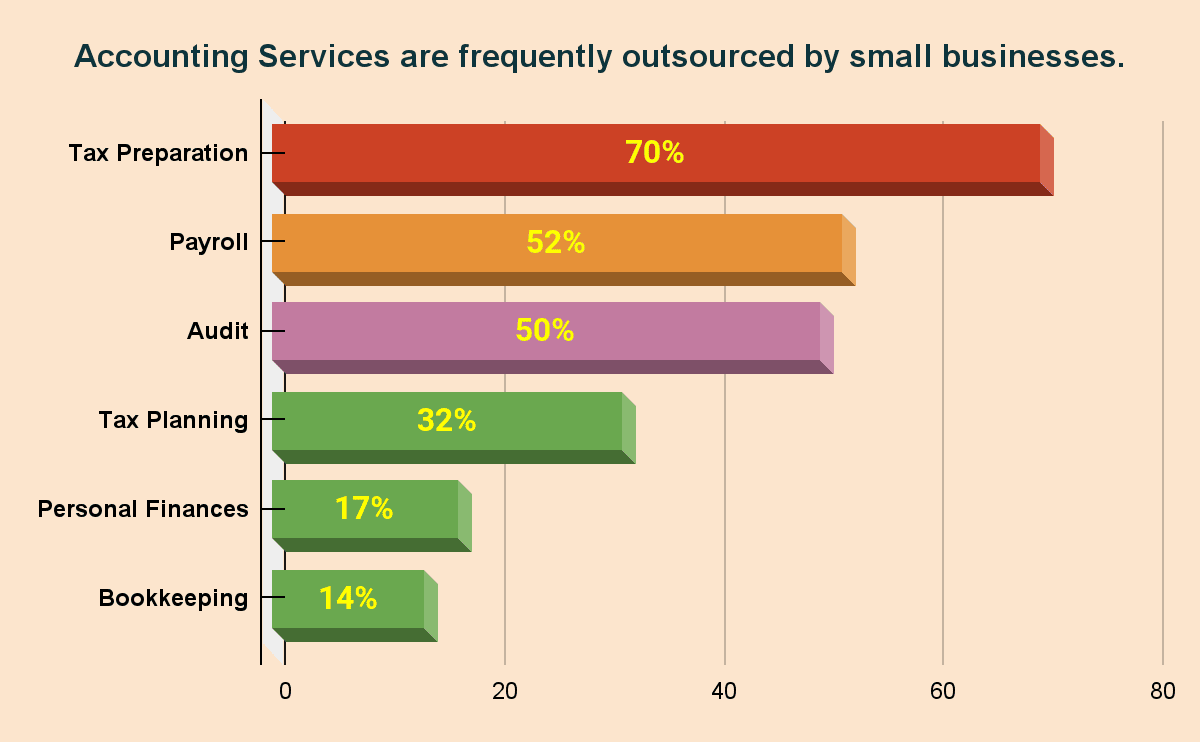
Core Outsource Accounting Services in Bangladesh
1. Accounts receivable: Tracking receivables is essential not only for credit decisions, but for accurate invoicing and healthy customer relationships.
2. Accounts payable: The record of what the company owes its suppliers — managed well, it captures cash discounts and keeps every payment on time.
3. Inventory accounting: The control account for monitoring and securing stock. It supplies the data behind correct stock levels, purchasing decisions, and turnover ratios.
4. Payroll: The full record of salaries paid and payable, and the basis for calculating and filing payroll taxes correctly.
5. Cash book: Every cash inflow and outflow in one place — the critical view of cash movement and reserves that keeps the business liquid.
Frequently Asked Questions
What is the biggest challenge of outsourcing accounting?
Trust and communication. Language, culture, and time zones are logistics problems with known fixes; internal resistance and unclear communication are what actually derail outsourcing relationships.
Is outsourcing accounting cost-effective for small businesses?
Usually, yes. Flexible engagement models — hourly, seasonal, or full-time — mean a small business pays only for the accounting capacity it uses, instead of carrying a full in-house finance function year-round.
How do you manage time-zone differences with an outsourced accounting team?
Split communication by urgency: live calls or chat for critical items, email for routine work, and scheduled handoffs so finished deliverables arrive before your working day begins.
Conclusion
Bookkeeping and business process outsourcing keep growing worldwide because the trade works: dramatically lower operating costs, access to better technology and skills, and a sharper organizational focus on core competencies. The challenges are real but manageable. Companies planning to outsource accounting should address language, culture, time zones, cost, and trust up front — protecting the provider relationship is what protects the return on the outsourcing investment.