

3 Common Payroll Problems And Solutions To Be Aware Of
Payroll processing issues — delayed salaries, tax errors, and security gaps — are resolved through automation, payroll audits, and outsourcing. Payroll processing itself means calculating and administering every payment a company owes its employees. In Bangladesh, payroll providers take over that entire payment process for the employer, from employee data to final disbursement.
Payroll mistakes cost twice: a single miscalculated pay cycle can produce unhappy employees and tax penalties at the same time.
Fun Fact: The amount an employee actually receives after tax and all other deductions is known as net pay.
What Is The Process Of Payroll Outsourcing?
Payroll outsourcing hands employee compensation to an external provider: the provider tracks labor hours, calculates earnings, withholds income tax and other deductions, delivers payments, and pays government employment taxes. The payroll process runs in three stages — activities before, during, and after each pay run — and every stage contains several distinct tasks.
Payroll work also demands regular monitoring of change, because tax withholding, statutory contributions, and reporting requirements shift over time.
Key Elements
- Payroll is the salary a company must pay its employees on a regular basis.
- Payroll processing covers tracking hours worked, calculating pay, and sending payments by direct deposit or check.
- Payroll calculation has many moving parts and can be difficult to run manually.
How Much Does Payroll Management Cost?
Manual payroll management takes around 11.67 hours to prepare 100 time cards, so timesheet processing costs $175.05 per payroll period at an estimated clerical rate of $15 per hour. The majority of small firms also invest $1,000 or more each year on tax administration, administrative costs, and legal fees, with the reported annual spend breaking down like this:
| Percentages | Spend |
| 23% | Less than $1000 |
| 31% | $1000 – $5000 |
| 18% | $5000 – $10000 |
| 12% | $10000 – $20000 |
| 16% | More Than $20000 |
What Are The Advantages Of Payroll Processing?
Payroll processing involves far more than issuing checks: the function maintains records, calculates deductions, and keeps tax payments accurate. Efficient payroll processing delivers five advantages:
- Accuracy and compliance: Payroll errors create unhappy employees and legal exposure. Proper payroll processing keeps paychecks accurate, meets tax laws and other regulations, and minimizes penalties for errors or late tax payments.
- Time savings: Payroll consumes hours, especially in a business with a large headcount. Automating or outsourcing the process returns that time to other critical areas of the business.
- Cost-effectiveness: A payroll system or outsourcing contract carries a setup cost, but the investment reduces the time spent on payroll and the losses tied to errors, late tax payments, or non-compliance.
- Improved record keeping: Payroll processing maintains comprehensive records of employee compensation, tax payments, and other deductions — records that support financial planning and regulatory compliance.
- Employee satisfaction: Timely, accurate payment keeps employees satisfied and sustains good employer-employee relations.
How Does The Payroll Management Process Work?
Payroll services determine employee compensation, deductions, tax calculations, bonuses, and compliance. The key steps in the payroll process appear below:
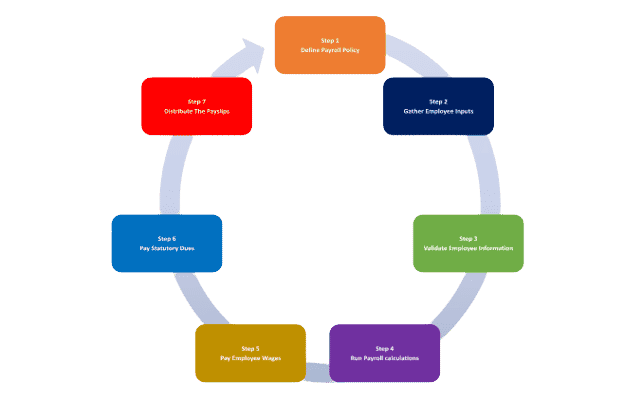
How Can Payroll Processing Issues Be Resolved?
The three most common payroll problems — slow manual configuration, weak data security, and an overloaded payroll team — are resolved the same way: move payroll onto automated cloud software, run frequent payroll and compliance audits, and digitize routine tasks so staff handle exceptions instead of data entry.
1. Payroll configuration that takes ages: In-house payroll consumes serious time in any business. Hours spent preparing data, double-checking completed work, complying with government requirements, and computing the fine details of compensation and deductions belong in other critical company duties.
Solution: Automatic cloud payroll software delivers a smooth pay run, saves those hours, and removes the burden of payroll technicalities.
2. Safety and security concerns: Confidential employee information stored in clumsy spreadsheets creates a serious security risk. Payroll fraud takes forms such as false pay and commission, ghost workers on the payroll, and feigned injuries filed as insurance claims.
Solution: A complete cloud payroll platform, frequent payroll and compliance audits, and random database inspections together close this gap.
3. Payroll team’s burden: Manual or antiquated payroll systems force staff to repeat the same tedious duties, which lowers morale and drags down overall productivity. Outdated tools also make producing reports and sharing information inside the firm difficult.
Solution: Digitization of the payroll function matters most here. Specialized software removes the repetitive workload and raises the company’s productivity.
Did you know? Pay accuracy drives retention — 49% of workers say just two problems with their pay would prompt them to start looking for a new job.
Payroll Processing In Bangladesh
Bangladesh is steadily expanding its business opportunities, and companies of every size employ large numbers of people. Growing businesses require payroll processing to collect employee information, handle benefits, and distribute employee payments. Numerous payroll service companies operate in Bangladesh, offering payroll outsourcing, tax consulting, payroll administration, third-party payroll, HR information systems, and payroll software.
Is It Difficult To Manage Payroll?
Yes — payroll processing is complex even for a small business. The employer must collect employee data, compute each employee’s gross pay, and handle every remaining step, which demands significant time and effort. Proven payroll software simplifies the whole procedure by performing every calculation automatically.
Final Words
Today’s workforce keeps evolving, yet paid employees, gig labor, and independent contractors remain central pieces of the puzzle. Falling behind on payroll developments leaves a firm exposed to legal risk, so unresolved payroll processing issues deserve attention now rather than later. A small business can either formalize payroll procedures internally or work with an external payroll provider — often the easiest and most cost-effective route. For more problem-solving guides, please read our blogs.
Frequently Asked Questions
What are the most common payroll processing issues?
The three payroll problems companies face most are payroll configuration that consumes excessive staff time, security risks around confidential employee data — including fraud such as ghost workers and false pay — and an overburdened payroll team stuck repeating manual tasks, which lowers morale and slows internal reporting.
How do companies fix payroll errors and delays?
Companies fix payroll errors by moving from manual spreadsheets to automated cloud payroll software, scheduling frequent payroll and compliance audits, and randomly inspecting payroll databases. Digitizing the process removes repetitive data entry, reduces miscalculations, and frees the payroll team to focus on exceptions and higher-value work.
Why do businesses in Bangladesh outsource payroll processing?
Businesses in Bangladesh outsource payroll because providers collect employee information, handle benefits, and distribute payments on the company’s behalf. Local providers also offer payroll administration, tax consulting, third-party payroll, HR information systems, and payroll software — letting growing firms stay compliant without building an in-house payroll department.